






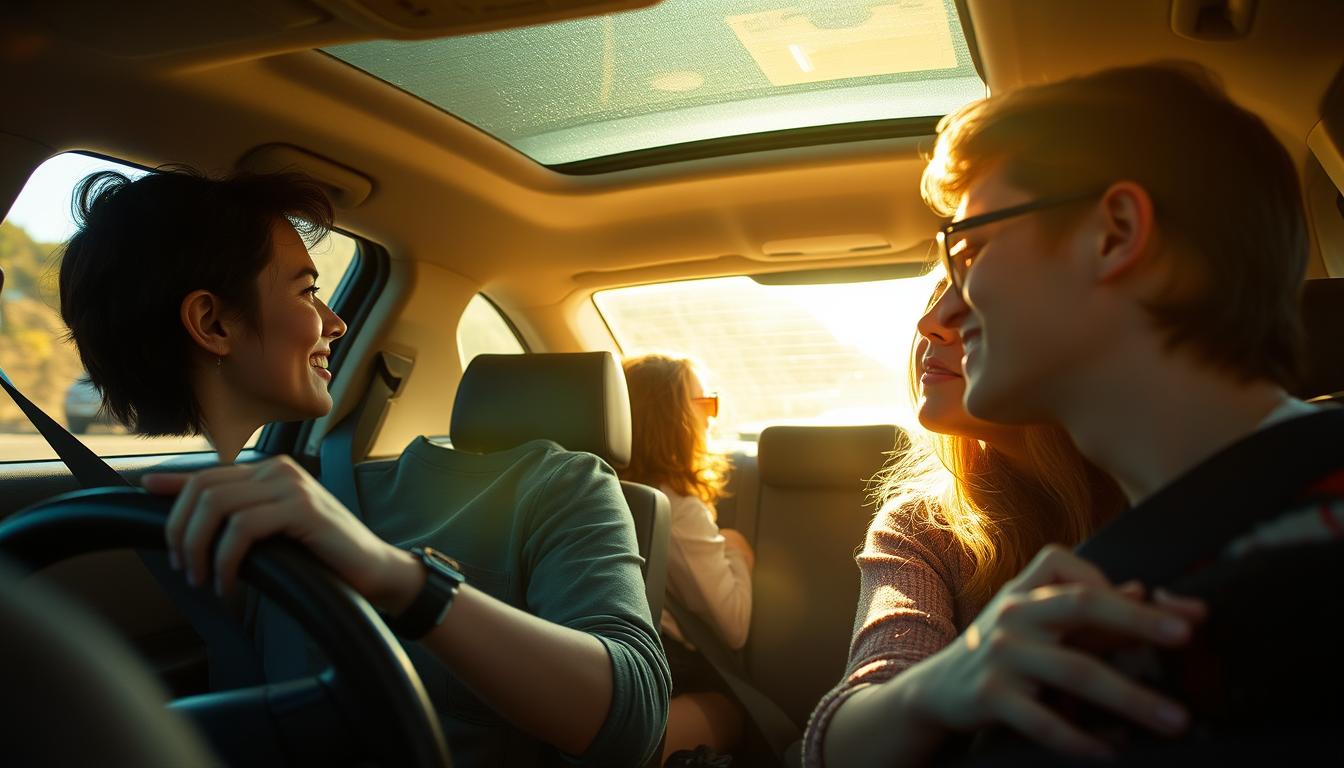
Car conversations create deep connections on the road. They turn simple trips into meaningful moments. The car’s small space makes it easy to share goals and feelings.
Screen-free drives help families focus on each other and the view. These talks, full of laughter and learning, connect us all. They make every mile special.
Studies show that facing forward and sitting side by side makes talking easy. Without direct eye contact, families share their dreams and worries. These conversations build trust and shared goals.
From family vacations to weekend trips, the car is a place for connection. Even long drives strengthen family bonds. The next sections will show how these moments shape our relationships.
The Magic of Car Conversations
Car rides are more than just getting from point A to point B. They’re where meaningful discussions happen. The car’s closed space makes it a perfect place for sharing secrets.
Studies show 80% of young drivers believe these moments are key for car ride bonding. They help create bonds that are hard to find elsewhere. Sitting next to each other makes it easier to talk without feeling judged.
Research also shows 21% of teens feel safer sharing secrets in cars. Kerry Parker, a 19-year-old from Los Angeles, says her deepest talks with friends started during aimless drives. “The road becomes a cocoon,” she says. “No one’s distracted by phones or surroundings.” Even small things, like shared playlists or the sound of tires, help build trust.
“The passenger seat is where truths come alive.”
Psychologists say side-by-side chats break down social barriers. Both teens and adults use cars to share fears or dreams. Next time you’re driving, let the journey unfold. Your next big conversation might be just ahead.
Disconnecting from Distractions
On the open road, the simplest way to boost safety and connection is to silence devices. Over 3,500 lives were lost in 2021 due to distracted drivers. This shows how smartphones and in-car tech steal focus from travel conversations. The National Highway Traffic Safety Administration reports 9% of fatal crashes stem from distractions.
Even hands-free calls or voice commands pose risks. This is a clear warning sign of how highway talks get drowned out by notifications.
“Texting while driving increases crash risk by 23 times,” warns the National Safety Council, highlighting how highway talks get drowned out by notifications.

Modern vehicles come with systems rated for distraction. The Mazda 6’s Connect system scored a 4.6 distraction level—nearly maximum—while Apple’s Siri reached 3.8. Even in-transit communication suffers when drivers battle voice menus or glance at glowing screens.
Studies show hands-free isn’t safe: mental focus lags for 27 seconds after a distraction. This is enough to miss a stop sign or a friend’s joke.
Turning off phones creates space for real connection. A 10-minute drive without screens can spark deeper travel conversations. Experts recommend planning routes with extra time to avoid rushing.
This lets drivers focus on the road—and each other. When voices replace devices, journeys become more than just getting from A to B. They become moments of shared focus and meaningful talk.
Deepening Relationships
The car’s small space can spark building relationships in car through honest talks. Whether it’s a quick drive or a long trip, driving offers a chance for family talks in car. This experience, known as automotive therapy, connects hearts through shared moments.
“The car’s movement mirrors the flow of conversation—unscripted yet purposeful.” – Dr. Lena Torres, Social Psychologist
Psychologists say the car’s tight space helps people focus on each other. Parents and teens have deep talks during drives. Couples solve problems without the stress of formal meetings. Listening well in these moments boosts empathy and understanding.
Research shows listening actively in these settings can make relationships 70% happier. The car’s neutral space, free from distractions, creates a safe place for talks. Whether you’re facing traffic or scenic views, these conversations strengthen bonds and build trust. Next time you drive, remember: the best connections are made one mile at a time.
The Role of Silence
Car rides don’t always need constant chatter to feel meaningful. Silence during driving dialogues can be as powerful as words. Unlike noisy social settings, the car’s confined space lets quiet moments become shared pauses for reflection.

The film Drive My Car, nominated for Best Picture, uses prolonged silences to deepen its journey discussions. A key scene cuts all sound, letting unspoken emotions speak louder than dialogue. This mirrors real-life road trips where pauses let thoughts settle before deeper talks begin.
“Silence isn’t empty—it’s where ideas grow,”
researchers studying creativity noted. Studies show even brief quiet periods during drives can boost focus and reduce stress. Historical figures like Einstein relied on solitude to innovate, proving silence fuels connection in unexpected ways.
Quiet moments during road trip conversations can be intentional. Try starting with 5 minutes of calm, using brown noise (like rainfall) to mask distractions. Over time, these silent breaks let minds process emotions without pressure. Silence isn’t awkward—it’s a space where trust grows, letting drivers reconnect with themselves and each other.
Next time the car falls quiet, let it linger. Those pauses might just spark the most honest journey discussions later.
The Impact of the Journey
Where you’re heading shapes every conversation. A road trip to the mountains might inspire tales of past climbs. Driving to a job interview could bring nerves and encouragement. Deep connections while driving often form when shared goals meet open roads. Conversations about a graduation or a move feel different with ever-changing scenery outside the window.
The road’s metaphor mirrors life’s path. Travel communication deepens as miles pass. Stuck in traffic, worries surface. On an open highway, dreams take flight. These exchanges become road trip memories, blending the trip’s details into the conversation’s fabric.
A long drive to college becomes a rite of passage. While a weekend getaway’s chatter lingers as cherished stories. Every turn and traffic jam offers a chance to connect. The journey isn’t just about arrival—it’s where bonds form through shared experiences.
Whether laughter or silence fills the car, the road becomes a space for growth. Proving that sometimes the trip itself is the destination.
Exploring Vulnerability
Car rides offer a safe space for sharing deep thoughts. The passenger seat confessions start with casual talk but soon turn into deep conversations. Therapists say the focus on the road makes it easier to open up without feeling judged.

“The rhythm of driving becomes a shield,” says Dr. Lena Carter, a relationship therapist. “Steering wheels and passing scenery become distractions, letting words flow naturally.”
Studies show that meaningful discussions during car rides can lead to big breakthroughs. Acting workshops, led by Bogdan Tabacaru, also found this to be true. Exercises that use touch and silence mimic the trust-building that happens in cars.
Drivers might talk about their job worries or family issues. Passengers, feeling free, share their regrets or dreams. These moments, often sparked by a beautiful view or a long silence, are key in building relationships. When the road is the setting, being honest feels safer and more natural.
The Influence of Music
Music makes road trips special, turning simple travel conversations into unforgettable moments. Research shows 94.86% of drivers enjoy music, with classic rock being a favorite. A study with 16 drivers found that music does more than just play in the background.
Slow music relaxes, while fast beats energize. This affects how we connect with each other in the car. Whether it’s singing along or discussing songs, music plays a big role in our road trip memories.
Playlists are a big part of vehicle dialogue. Loud music might make us drive faster but can also distract us. On the other hand, soft music (65 dB) helps us relax.
Singing along or debating songs creates lasting memories. For example, 62% of drivers say music helps them unwind. It opens up conversations about life and plans.
“A shared playlist is like a silent agreement to connect,” says Dr. Lena Torres, a driving behavior researcher. “The right song can turn a quiet car into a confessional.”
Research followed drivers for 64 days, showing how music affects our mood. Slow songs help us stay awake on long drives, while upbeat tracks keep us awake at night. Even small music choices, like skipping a song or asking for a 90s hit, add to the journey’s story.
The right song can make a drive memorable. It shows that music is more than just sound. It connects us, bridging hearts and highways.
Creating Lasting Memories
Family talks in car rides often become the fabric of cherished road trip memories. A 7-week winter session in Peru or a trek to Annapurna Base Camp can etch conversations into minds long after the journey ends. The blend of motion and intimacy creates a unique space for in-transit communication, where distractions fade and bonds strengthen. Research shows 60% of parents rank vacations as top memory-makers, yet many overlook the power of everyday drives.

“Happy memories act like anchors,” writes Meik Wiking, author of “The Little Book of Lykke.” “They shape who we become.”
Consider how a child’s first “big talk” during a drive to Disneyland becomes a lifelong reference point. The Viv Hotel in Anaheim, near iconic attractions, or Universal Studios’ movie-themed rides create backdrops for these moments. Even brief exchanges—like debating song choices or sharing fears—can crystallize into memories. A social worker with 35 years of experience notes that these talks help children build decision-making confidence early, starting as toddlers.
Documenting these gems? Voice memos or mapping conversation spots (like the “bridge where I confessed my fears”) help preserve them. Families who revisit routes or traditions, like annual drives along Route 66, see 50% stronger emotional bonds. As the author of Topic of Cancer—winner of six literary awards—observes, even hard conversations in cars can become cherished parts of a family’s story. The next time you’re driving, let those moments linger. They’re more than talks; they’re the threads of tomorrow’s memories.
Building Trust
Trust grows quietly, like roots beneath the surface. Regular highway talks during daily commutes create the soil where it thrives. Teens feel 70% misunderstood by parents, but the car becomes a unique space to bridge that gap.
When conversations happen naturally, without pressure, they build a foundation of reliability. A study shows active listening boosts teen-parent dialogue by 50%—proof that focused attention matters.
“The car’s confined space, free from audience and distractions, becomes an automotive therapy session. Here, emotions surface without the weight of judgment.”
Parents can turn drives into safe zones by asking open-ended questions. Eighty percent of teens prefer this style, leading to deeper sharing. Respect privacy: when teens feel heard without interruption, they’re 40% more likely to open up.
Teens also crave honesty—90% want parents to acknowledge their feelings without immediate advice.
Consistency matters. Families who prioritize weekly car chats see stronger bonds. Even small talk about the day or music choices plants seeds of trust. Over time, these moments turn into a language of connection, proving that building relationships in car isn’t just casual—it’s foundational.
Encouraging Future Connections
Every drive is more than just getting from point A to point B. Car conversations make these trips special, deepening our bonds. With the average U.S. household spending over $12,000 yearly on transportation, making every mile count is key. Plan topics that fit the journey’s length—big discussions for long trips, light chats for short ones.
Creating space for journey discussions means turning off devices and tuning into shared experiences. Families can start traditions like “weekly road trip chats.” This mirrors how Dutch safety innovations cut crash deaths to 4 per 100,000, showing the power of intentional choices. Even as Hitachi’s new automotive systems improve safety through data, the human element remains key.
Conversation starters like “What’s one thing you’re grateful for?” or “What’s a dream you’ve never shared?” invite vulnerability. Hitachi’s focus on autonomous tech and connectivity shows progress, but true connection needs conscious effort. Use drive time to ask questions, listen deeply, and turn routine routes into memory-making opportunities.
Technology evolves, but the need for human connection stays constant. Whether in a $48,000 new car or a family road trip, every drive can become a space where voices rise above engine noise. Let’s choose conversations that matter—because the roads we share are also bridges to understanding others.