






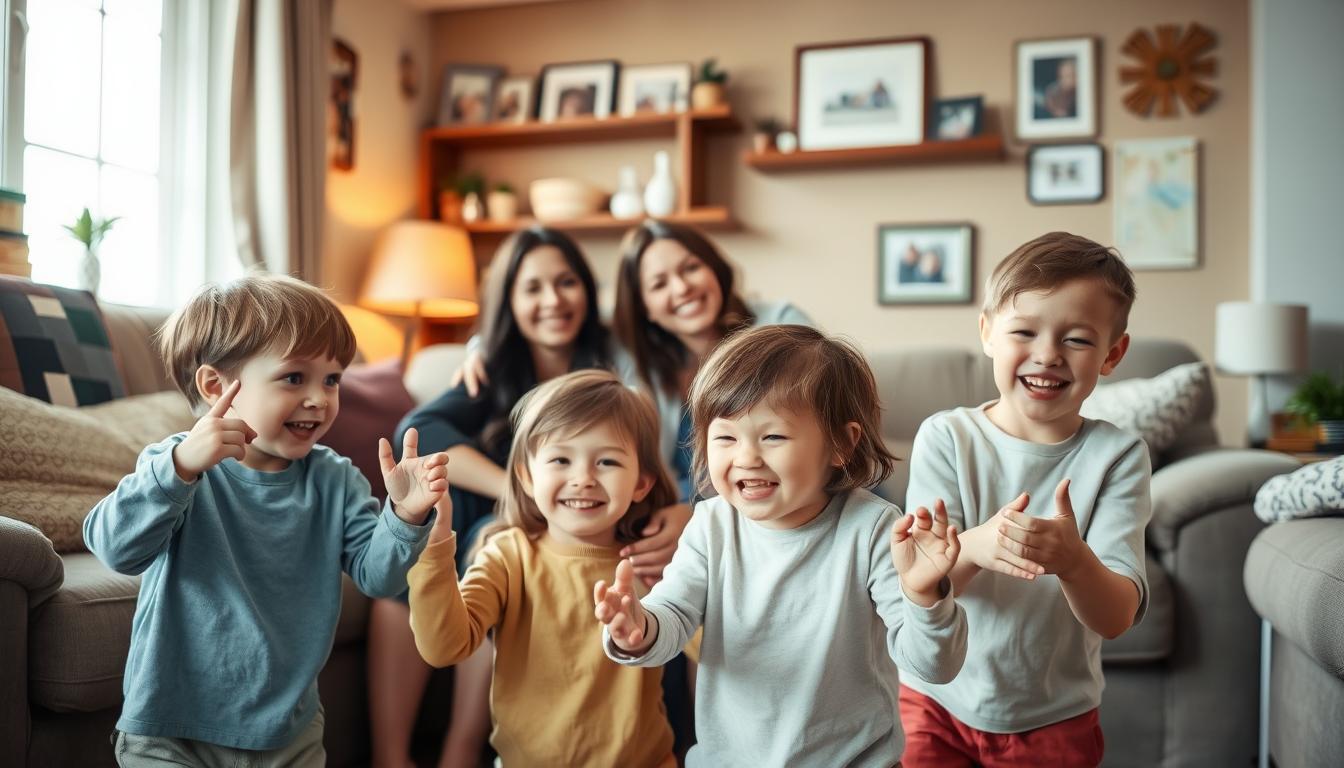
Have you ever seen your toddler “brushing” their hair with a spoon or mimicking a phone call with a banana? These moments are not just cute. They are important for their growth. Child mimicry starts early, with even infants mirroring facial expressions.
By age two, kids become “master mimics,” learning from everything around them. Whether it’s pretending to type on a laptop or saying “please,” these actions show how much they observe and absorb. They learn by doing, not just watching.
Behind the giggles of kids imitating parents lies a learning powerhouse. Toddlers aged 12–36 months learn by doing, not just watching. A study found over 90% of toddlers repeat actions that make others laugh, like exaggerated gestures or playful noises.
This mirrors how children store both good and bad behaviors they see daily. When parents read books or say “thank you,” kids notice—and often copy those actions. Understanding why kids imitate parents is key. It shapes their social skills and habits for years to come.
Understanding the Concept of Mimicry in Children
Developmental mimicry is a natural way children learn. Studies in Amsterdam followed 117 infants. They found out mimicry starts early.
At six months, babies mirror facial expressions like smiling. By twelve months, they copy complex actions. These stages are key for social learning, helping them understand emotions and interactions.

Infants who mimicked happy expressions had parents who mirrored them longer. This shows a strong bond. It also helps their brains grow, making learning easier.
By 16 months, kids use mimicry to solve problems. They might use a tool after seeing adults do it. In experiments, mimicked infants did better than others.
Social learning in children is not just copying—it’s survival. Humans are wired to learn from caregivers. This ensures skills are passed down through generations.
Even at four months, babies start testing these skills through play. This is the start of their curiosity. Programs like Little Inventors use this to boost creativity and confidence.
Knowing these stages helps parents support healthy mimicry. When children imitate, they’re learning empathy and communication. By joining in activities, adults help their cognitive growth. This turns mimicry into a tool for lifelong learning.
The Role of Observational Learning
Observational learning in toddlers is a powerful tool for growth. Albert Bandura’s research shows children how kids learn by watching others act, think, and feel. This process unfolds in four steps: noticing a behavior, remembering it, trying it out, and being driven to repeat it.
Imagine a toddler copying a parent’s “please” and “thank you.” They’ve paid attention, stored the words, practiced the phrases, and now use them to get positive reactions.
Mirror neurons in children act as nature’s built-in teachers. These brain cells fire when kids observe actions, helping them grasp emotions and intentions. A smile or frown mirrored back builds empathy, showing how social cues are absorbed without words.
“Learning would be exceedingly laborious if dependent only on random trial and error,”
noted Bandura, highlighting how observation cuts learning time.
His Bobo doll experiments proved kids mimic aggression or kindness based on what they see. When a model faced consequences, children were less likely to copy harmful acts. This shows motivation matters—kids repeat behaviors linked to praise or rewards.
Parents’ reactions shape what sticks. Even at 2 years old, toddlers start linking observed actions to outcomes. This lays the groundwork for social skills and self-control.
Daily Habits That Kids Often Mimic
Children are natural observers, soaking up every action they see. They copy everything from morning routines to bedtime rituals. A toddler might brush teeth with a toy brush or squirt lotion like perfume.
Studies show that 65% of kids mimic their parents’ eating habits. They often choose the same snacks and follow the same mealtime behaviors.

Cleaning and chores become teachable moments too. Children imitating housework might sweep with a tiny broom or “cook” pretend meals. This play reinforces responsibility.
But what about the digital world? Toddlers mimicking phone use is common. They fake scroll, “answer” calls, or press buttons on toys. Research shows 60% of kids mirror parents’ screen time habits, highlighting the need for mindful tech use.
“Mirror neurons in the brain light up when kids observe actions, making mimicry a biological learning tool,”
explains child development research. Parents can turn these moments into lessons. A child wiping counters with a sponge isn’t just playing—they’re learning.
Even “helping” fold laundry builds skills. The key? Let them participate safely, turning imitation into growth opportunities.
Positive Effects of Mimicking Daily Habits
Children’s mimicry is a powerful tool for growth. When kids copy adults, they learn new skills. Simple tasks like setting tables or watering plants teach responsibility. Even infants mirror facial expressions, building early communication skills.
Cross-cultural studies show that mimicking every adult action helps kids absorb cultural values. These early efforts build self-confidence and practical know-how.

Positive mimicry in kids also sharpens social awareness. Watching adults handle emotions teaches emotional regulation. Observing parents helping others shows generosity in action.
These lessons form the basis of empathy, letting children grasp others’ perspectives. For instance, seeing what researchers found:
“Children who observe problem-solving behaviors show stronger critical thinking,” says Dr. Rivi Frei-Landau’s team. “Watching adults navigate challenges builds mental flexibility.”
Shared activities like cooking or gardening create lasting bonds. The University of Munich’s ongoing study explores how parents mirroring kids’ play impacts their imitation abilities later. These interactions foster trust and mutual respect, turning daily chores into teachable moments.
Even small rituals, like bedtime chats, become meaningful when done together. Research shows that mimicry helps kids internalize values and skills. While copying every step might seem redundant, it’s how they decode cultural expectations.
Encourage imitation by demonstrating patience and kindness. Every time a child repeats a gesture, they’re practicing social and emotional learning—laying the groundwork for lifelong competence.
Potential Negative Impacts of Mimicking
Children often learn bad habits by copying what they see. This can include unhealthy eating or too much screen time. These habits can harm their health and well-being.
For example, kids might pick up on adults’ stress behaviors. They might learn to handle stress in ways that aren’t good for them. This is because they are just copying what they see.

It’s important for parents to be aware of this. If parents yell during fights, kids might start yelling too. Studies show that watching too much violent TV can make kids act out more.
Children absorb behaviors through observation, even when adults try to shield them.
Screen time is a big issue today. Too much screen time in preschoolers can hurt their social skills. Parents can set a good example by limiting their own screen time.
Organizations like May Institute help teach kids positive behaviors. They use ABA therapy to reinforce good habits. This helps kids learn to make better choices.
Small changes can make a big difference. By noticing and praising good behavior, we encourage kids to do more of it. By being mindful of our own actions, we help create a positive environment for kids to grow.
Encouraging Healthy Mimicry
Parents can help kids grow by guiding their natural mimicry. Promoting positive mimicry begins with actions. When kids see adults doing healthy things, like washing hands or sharing, they learn.
Small actions, like staying calm when upset, teach kids to manage emotions.
Give kids chances to practice and they’ll feel more confident. Letting them use small tools for cooking or cleaning is safe and fun. It makes them feel like they’re part of the family.
By 18 months, kids start to imitate what they mean, not just what they see. This is a key time to teach them values.
Talking about what you’re doing helps kids understand why. Saying, “I’m putting away toys because it keeps our space tidy,” teaches more than just tidying. Praise kids for trying, even if they’re not perfect. This shows that effort is important, not just being perfect.
Verbal games like nursery rhymes or call-and-response games help kids with language. They learn by mimicking.
Mistakes are chances to learn. When adults say they made a mistake and how they fixed it, kids see that it’s okay to fail. Doing this often helps kids develop good habits and skills for the future.
The Power of Play in Learning
Play is more than just fun—it’s essential for growth. Role play in child development helps kids learn social skills like sharing and empathy. For example, a child using a toy doctor kit to “heal” a teddy bear shows the pretend play importance.
This play lets children act out real-life scenarios. It builds problem-solving and emotional understanding. Through imitation through toys, like play kitchens or tool sets, kids practice communication and creativity.
“Play is the work of childhood,” said pediatrician T. Berry Brazelton. “It’s how kids explore the world safely.”
Guided play offers a mix of structure and freedom. When parents join in, they can teach new things naturally. For instance, a pretend grocery store game can teach counting and boost imagination.
Research shows guided play improves spatial skills and vocabulary more than free play alone (Fisher et al., 2013; Toub et al., 2018).). Even 15 minutes of play before school can make kids feel more ready to learn.
Choose toys that spark curiosity. Dolls, kitchen sets, or building blocks encourage imitation through toys by mirroring real tools. The American Academy of Pediatrics suggests focusing on unstructured play to build resilience against stress.
Let kids lead their playtime. Sometimes, offer suggestions, like turning a cardboard box into a spaceship, to spark creativity.
Supporting Effective Communication
Children learn language quickly, picking up words, rules, and tone. By age one, they often say their first words. This starts their journey in communication development.
Reading books and singing songs every day helps a lot. In the U.S., Early Intervention Programs offer free help for kids who need it. If you notice any delays, get help early.
Children are mirrors of our actions, reflecting what they see and hear daily.
Smiles and gestures teach kids about emotions. When parents listen and nod, kids feel understood. This boosts their confidence in sharing their thoughts.
Praising their efforts, like saying “Great job explaining!”, helps too. It encourages them to keep trying in communication development.
Kids learning social norms also comes from watching adults. They learn how to greet, share, and solve problems. Cultural differences add to these lessons, but clear examples help all kids.
Playing games or pretend can make learning fun. Labeling feelings in stories, like “The character feels happy!”, helps kids connect words to emotions.
Celebrating Unique Traits and Individuality
Every child’s journey is as unique as their fingerprints. While mimicry helps kids learn, it’s important to nurture their unique personality. Studies show siblings share just 20% of personality traits, proving innate differences thrive even in shared homes.
Parents can embrace this by balancing mimicry and independence. This means guiding without stifling self-expression. It’s about finding the right balance.
Supporting unique personality starts with observation. When a child prefers drawing over sports, or asks questions in their own way, these are cues to foster their strengths. Middlesex Health recommends tailoring activities to each child’s interests.
Letting kids take the lead in creative projects or storytelling can amplify their voice. This improves self-expression by 30% according to recent studies.
Parents also shape legacies through values. Modeling kindness or curiosity gives children roots, while allowing them space to explore their passions lets wings take flight. By honoring their choices and celebrating quirks, we help them grow into confident individuals.
The joy lies in watching them become their truest selves. They mirror our love while blazing their own trails.