






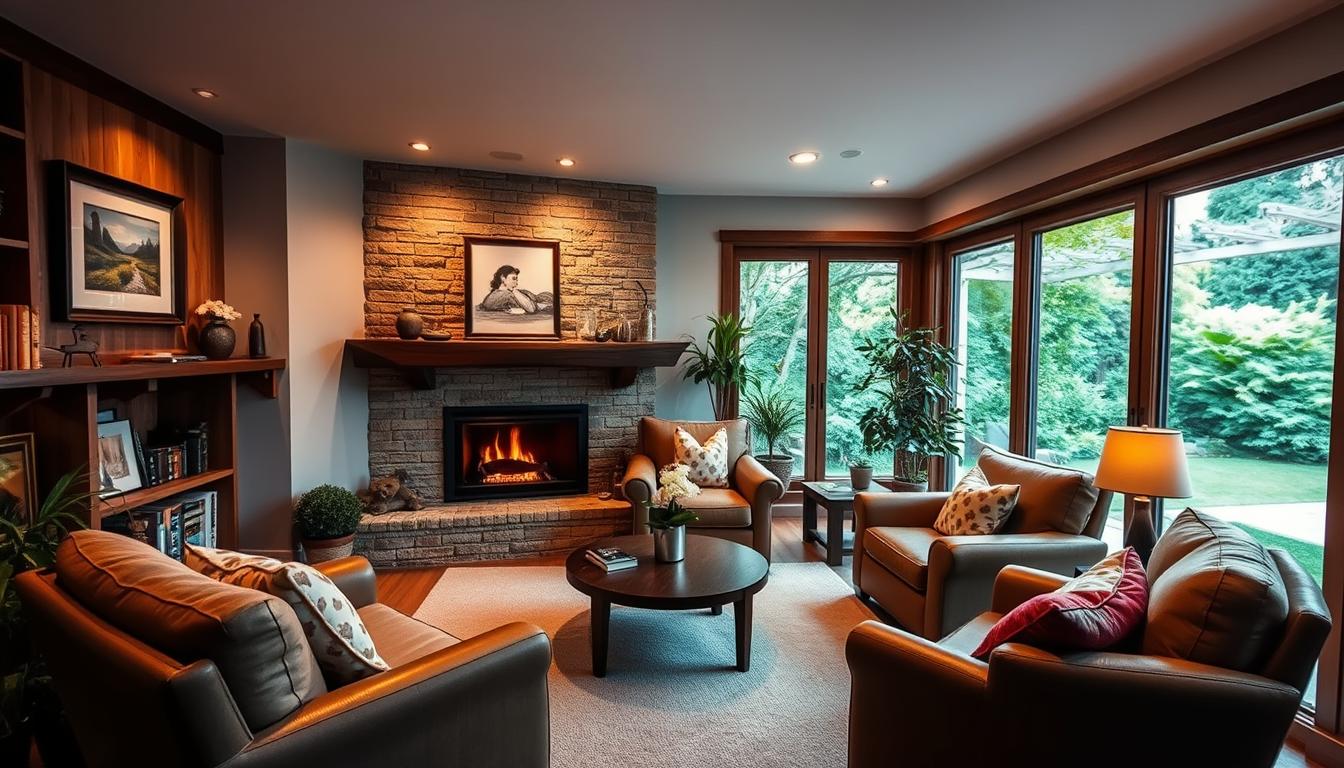
Have you ever walked into a space and felt instantly at ease or uneasy? This feeling is more common than you think. Over 60% of people see their homes as places for work, rest, and connection. Yet, many struggle to find a space that truly feels like home.
For some, it’s a gut feeling. They can sense “energy” in a home the moment they enter. This emotional connection goes beyond layout or style. It’s about how a space makes us feel.
Studies show why: 75% of homeowners say sentimental items like photos or heirlooms make them feel at home. 70% also link well-designed spaces to happiness. Even soft furnishings, like rounded furniture, tap into our instinct for comfort.
These elements combine to create a home feeling that’s personal yet universally sought. As lifestyles change, more people are investing in redesigns. 40% now hire professionals to balance aesthetics with emotional warmth. It’s not just redecorating; it’s about creating a place where body and mind align.
Understanding Home as a Feeling
Home isn’t just a house. It’s a home psychology that comes from the heart. It’s like an emotional geography—a mix of memories, smells, and moments that make a place special. Ever felt calm when you enter a room? That’s your brain’s sense of belonging at work.
Studies show that emotional brain areas light up when we think of cherished spaces.
Our place identity grows from stories. Anthropologist Polly Wiessner found that shared tales by firelight created early human bonds. Today, 60% of people connect home to sensory details, like a parent’s perfume or a childhood book.
Even a phone call with family or a cozy café visit can make us feel at home. It’s why 70% say social connections anchor their sense of belonging.
But home isn’t always the same. Military kids or frequent movers might have multiple “homes.” The pandemic also changed routines. Yet, 80% say loved ones define their home more than walls.
Even objects, like a favorite mug or a handwritten note, carry emotional weight. It’s how we build home in our minds, not just spaces.
So, when you feel “at home” in a café or a friend’s porch, remember: it’s your brain mapping emotions to place. Home is wherever your heart’s story unfolds.
The Science Behind Place Attachment
Our brains quickly understand spaces before we even realize it. Environmental psychology and place neuroscience show how spaces affect us. Malcolm Gladwell said, “Intuition is your brain deciding before your logic catches up.” This is true when we feel if a room feels right or wrong.
“We are remarkably attuned to how things flow and fit, even when we can’t name it.”

Spatial cognition helps us understand layouts. Biophilic design uses nature, like sunlight or plants, to make us feel better. Studies show that open ceilings and natural light help us focus. But clutter can make us feel less connected.
Even things we can’t see, like electromagnetic fields or infrasound, can affect how comfortable we feel. Cultural rituals, like using Himalayan silk scarves at sacred sites, show how we mark spaces as meaningful. Research shows that owning a home can make us feel more attached. But too many people in a space can make us feel unhappy.
Our brains form stronger bonds with our homes than with neighborhoods. This is why some places feel like a part of us. Science and feelings meet in every corner.
Elements That Make a Place Feel Like Home
Home design psychology shows us what makes a space special. Natural light is key—it makes rooms feel cozy and inviting. A study found that warm lighting can make us feel 20% more comfortable.
“Light is another thing I think that can really affect the vibe of a place, either the artificial kind or window light.”
Sound and scent play big roles too. The sound of a ceiling fan or the smell of cookies can make us feel at home. Plants like pothos or succulents not only clean the air but also add life. Textured rugs and soft fabrics make a space feel warm and inviting.
Good layout and function are also important. Cluttered spaces can stress us out, while open kitchens and sunny spots encourage us to gather. Even small changes, like hanging a piece of art or decluttering, can make a big difference.
Begin with small steps: unpack the kitchen first, arrange seating for easy conversation, and add personal touches like family photos. These actions, based on home design psychology, turn a blank room into a cozy home. Every detail counts because building a home takes time and effort.
The Influence of Culture on Our Sense of Home
Cultural geography shapes how we design and experience spaces. In Poland, beliefs about underground energy “veins” affect home layouts. Japanese tokonoma nooks honor tradition. These home customs aren’t just decoration—they’re bridges to heritage.
Think of Scandinavian hygge’s cozy lighting or Chinese feng shui balancing energy. Each reflects cultural identity and place, proving that home isn’t just walls but a living story.

Cross-cultural living spaces highlight these differences. Immigrants in the U.S., for example, often blend old and new traditions. Over 5 million long-term older immigrants recreate family rituals, like Mexican altar de muertos or Indian rangoli designs, to anchor their cultural roots.
Even modern homes may hide subtle nods to heritage—a Moroccan tea set on a Chicago shelf or Korean hanok-style courtyards in Seoul apartments. These choices show how cultural identity and place merge, creating spaces that feel “right.”
Research shows 80% of South Asians tie selfhood to home environments. This ties to social theories like Carstensen’s work on emotional priorities as we age. Spaces filled with familiar objects—a Moroccan rug, a samovar—become anchors during life changes.
Even younger generations seek this: 60% of millennials prioritize neighborhoods over home size, balancing modern life with cultural memory.
Understanding these layers helps us see home as more than a house. It’s a mix of rituals, symbols, and shared beliefs that cross borders. Whether through a Vietnamese family altar or a Nordic minimalist kitchen, cultural geography reminds us that home is where our roots and surroundings grow together.
Personal Experiences that Define Home
Childhood homes shape our emotional maps, teaching us what comfort and belonging mean. The smell of a kitchen or the sound of a park can stay with us forever. These memories often influence our choices as adults, whether we realize it or not.
Recent movers reported having more unhappy days in a two-week testing period compared to those who had not moved.
By 2019, less than 10% of Americans moved each year. Yet, even small moves can break emotional ties to a place. Psychologists say that people often recreate details from their childhood homes. This is because our environments reflect our inner worlds.
Melody Warnick found that hosting dinners in new neighborhoods can help build connections. On the other hand, emotional neglect in childhood can make us feel out of place. Many adults struggle with feeling at home because of unresolved childhood issues.
Understanding these patterns helps us adapt to change. Whether through design or social rituals, our past and present experiences shape our idea of home. It’s a journey where every memory guides us.
The Role of Nature in Creating a Home Feeling
Our brains do best when nature does well. Natural elements in homes like plants or views of trees calm us. This biophilic connection is more than a trend; it’s part of our evolution.
A house built over an underground spring might face flooding issues. Yet, its connection to nature defines it. Even water leaks can’t break the bond with earth and water.

“Place attachment is positively associated with quality of life and life satisfaction.”
Tennessee National’s forests and lakes show the power of nature. People there enjoy hiking, fishing, and watching bald eagles. These activities boost nature and wellbeing.
Studies show these settings lower stress hormones. This proves landscape psychology is key. A home near woods or water feels natural because it taps into our ancient instincts for safety and beauty.
Communities like these promote health through gardens, trails, and clean air. Even small changes, like potted herbs or nature-inspired wall art, can deepen our connection. Design that respects nature is more than decoration; it’s a lifeline to calm and belonging.
Technology’s Impact on Our Sense of Place
Imagine a home where everything adjusts to your mood. Technology and home now shape how we bond with spaces. Digital tools like virtual tours or AR apps let us explore neighborhoods from afar. They blend physical and digital experiences.
Online communities create “third places” where friends feel close through video calls or shared digital spaces. This shows how virtual place attachment works.
Smart homes offer convenience with voice-activated systems or energy-saving tech. But, they raise questions. Do sensors monitoring our routines enhance comfort or create surveillance?
Studies show 70% of urban dwellers feel overwhelmed by tech-driven stimuli. Yet, 61% use AR apps to explore local landmarks. This shows how tech reshapes our bond with space.
Social media adds to this tension. Platforms let us document homes beautifully, but idealized posts can fuel dissatisfaction with real spaces. During the pandemic, 54% of smartphone users felt anxious without their devices.
This highlights tech’s role in both connecting and isolating us. Tools like telecommuting apps enable digital nomadism. They let people forge virtual place attachment across continents.
As smart environments evolve, finding a balance is key. Whether through AR-guided city tours or smart home automation, the challenge is to nurture authentic connections. We need to keep “home” meaningful in a digitized world.
The Importance of Personal Identity in Home
Your home is more than just a roof—it’s a canvas for place identity. It shows who we are, becoming a part of our self-expression. Studies reveal 75% of people see their homes as mirrors of their values and dreams.
These authentic living spaces are not just about looks. They are where our personal stories unfold.

Our belongings and relationships deeply connect us to our homes. Almost 42% of people tie their identity to their stuff, while 32% do the same with shared experiences. A tidy space can make us feel grounded, while clutter can be overwhelming.
For many, having a home that reflects them is essential for emotional well-being. Over 70% say losing their home, like in a burglary, makes them lose part of themselves.
Sites like Homeswapper.co.uk show people looking for homes that reflect their identity. Young renters, who often move every three years, want spaces that grow with them. Even small choices, like arranging a bookshelf or picking decor, help shape our home’s vibe.
A home that feels right mirrors our lives. It’s where we try out roles, celebrate our heritage, and build stories about ourselves. When our home aligns with us, it doesn’t just protect us—it nurtures our growth.
The Interplay Between Sentimentality and Space
Sentimental objects in homes often anchor our emotional attachment to places. A worn photo album or a table passed down through generations holds more than dust—it carries stories. For Max Daniels, downsizing meant parting with 80% of her belongings, yet a single childhood quilt defines her new living space. These items act as silent storytellers, weaving personal history into the fabric of where we live.
“I think dated decor is also a factor—it makes you very aware that this is someone else’s home, with decades of a very different life from yours.”
Memory-making in spaces transforms empty rooms into cherished environments. A kitchen where family meals were shared or a porch where summer nights were spent become sacred ground. Behavioral researcher Paco Underhill notes that even transient travelers like him seek spaces that mirror their inner worlds. Cluttered spaces, on the other hand, disrupt this process. Studies show physical mess correlates with stress, blocking the brain’s ability to form new emotional bonds with surroundings.
Cultural ties deepen this bond. The Hmong community mourns lost farmlands in Laos, their emotional attachment to places shaped by displacement. In Susurluk, Turkey, shared security rituals turn neighborhoods into extended homes. Tiny house dwellers like Steven Mejia prove that memory-making in spaces isn’t tied to size—80% fewer possessions didn’t erase their family’s story.
Creating emotional attachment to places requires active effort. Hanging art, rearranging furniture, or hosting gatherings are small acts of claiming a space as “mine.” Over time, these rituals layer new memories over old ones, letting us craft homes that reflect who we are today while honoring the past.
Moving and Redefining Home
Adapting to new homes is a journey filled with emotions and habits. Many people face a hard time leaving old spaces, but 55% of them create their own definition of home. For those who move a lot, like military families, home is more about routines and relationships than walls.
Imagine living in 15 homes across 3 states in a decade. This is the reality for many, like military spouses. They find comfort in shared meals or cherished objects. Research shows it takes 3–6 months to feel settled, but small, portable things like traditions or close ties help speed this up. Even a short stay, like a 1-month rental, can become meaningful with small rituals.
“Home is where you nurture what matters most,” says a veteran traveler who’s built community in 20 homes over 20 months.
Statistics show 48% see home as an emotion, not just a place. For 67%, self-care practices like gardening or journaling help recreate comfort. When moving, focus on what you can carry: photos, recipes, or daily habits. These small acts can turn any space into a place of belonging.
Finding Home in Shared Spaces
Shared living spaces are where family and community bonds grow. From big families to co-living, these places need teamwork. “A well-designed kitchen or shared garden can turn differences into connection,” says an architect who loves shared living spaces.
More than 65% of millennials choose to live with others. They see community as more important than living alone.
“70% of people feel at home when sharing meals or stories with others,” highlights a Harvard study on collective living. This aligns with the 75% who say emotional bonds matter more than brick-and-mortar walls.
Community building isn’t just for families. Parks, cafes, and markets become part of our homes. These collective sense of home spots help neighbors work together on gardens or throw block parties.
Designers now create rooms that can change, like sliding walls or modular furniture. When families talk about storage or decor, it’s more than looks. It’s about respecting each other’s stories.
Research shows 90% of people connect home to shared memories, not just size. This change helps families find a balance between alone time and being together. Whether it’s a big kitchen or a neighborhood playground, these spots become our roots.
By focusing on compromise and sharing stories, these shared spaces become places where everyone can do well.
Conclusion: Home as an Ongoing Journey
Home is not just a place we arrive at. It’s a journey that changes as we grow. The idea “You’re at your best when you’ve done what it takes to be at your BEST!” tells us our homes should match who we are. As we change, our connection to places deepens, whether through making our homes special or adjusting to big life changes.
Starting to make our homes meaningful begins with being aware. The Canadian-American Center’s map project, working with many Indigenous groups, shows how we can honor our roots and connect with others. Just like Yale students who found comfort in small acts of kindness during tough times, every choice we make in our homes adds to our sense of belonging.
Embracing change is key to growing our sense of home. A house becomes a home when it tells our story, like a desk by a window or a park where neighbors meet. Focus on creating spaces that make you feel good, just as *Sula* by Toni Morrison shows how places shape us. Home is a conversation between who we are now and who we will become.