






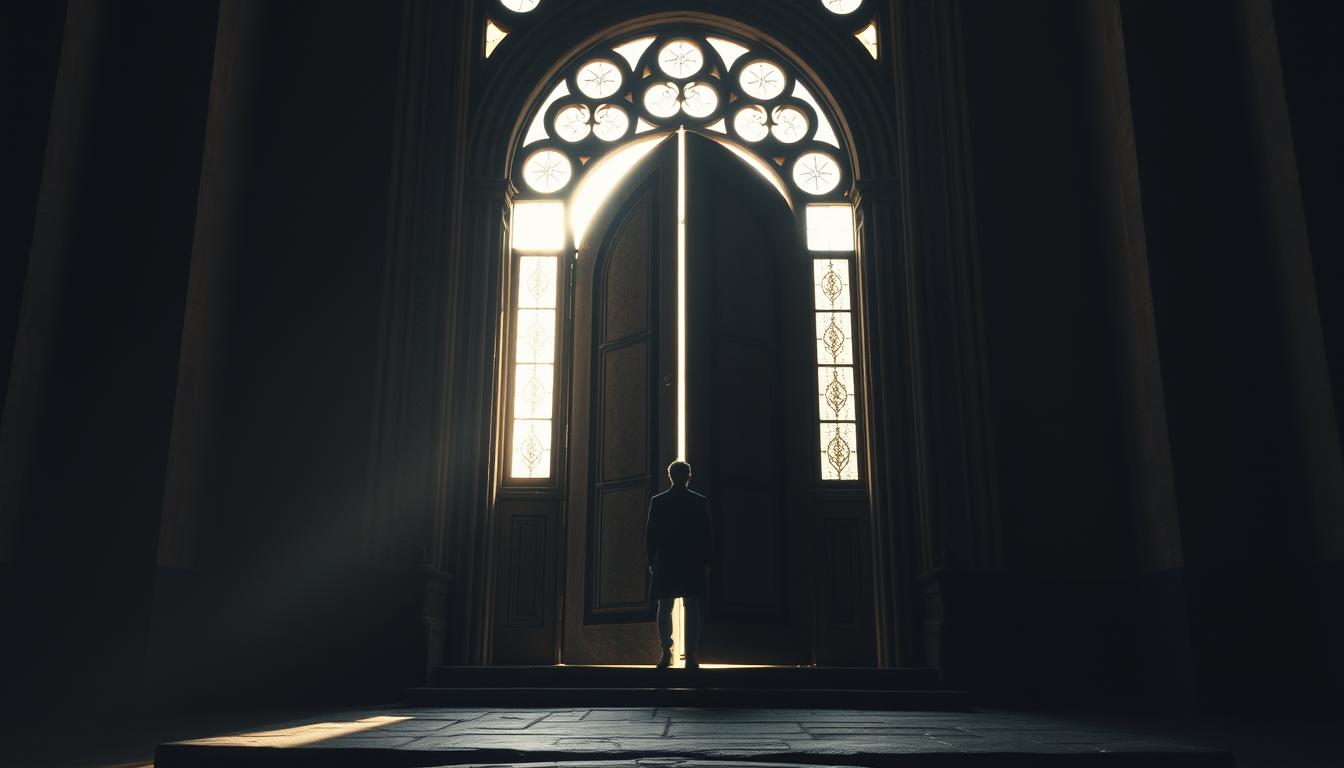
Life is full of seasons, and every step forward is a new chapter. Doorway symbolism shows us these changes, from moving homes to starting new relationships. Each moment guides us on our journey, shaping who we are.
Across the globe, cultures celebrate these changes with special rituals. In Africa, herbs like Abre Camino are used in “road opening” spells. In Britain, doorways are marked with CMB symbols for protection. These acts make everyday moments sacred, blending action with deep meaning.
Every doorway offers a chance to grow. Theosophy teaches us that change means facing our fears. This article looks at how symbolic passages, like candle rituals and cultural beliefs, help us through life’s changes. It shows how doorways can surprise us on our journey.
The Significance of Doorways in Our Lives
Doorways guide us through life’s paths. Every time we cross a threshold, we enter new chapters. These spaces are more than just physical barriers; they open doors to personal growth.
Our brains see doorways as markers of change. Walking through a door can clear our minds, like leaving work worries behind. This shows how doorways influence our mindset.
“I will set before you life and death; therefor choose life.”
The Bible talks about “door” over 400 times, showing choices as paths to purpose. Helen Keller’s life is a great example. Despite early challenges, she turned obstacles into opportunities. Her work for the disabled opened doors for many, showing that even closed doors can lead to growth.
Lockdowns made homes into liminal spaces during the pandemic. Mask rules and quarantines forced us to make choices between safety and freedom. Every decision was a threshold, affecting our health and relationships. Keller’s story shows that giving back can open doors for others, leading to progress for all.
Doorways teach us to embrace the unknown with each step. They are not just entrances; they are invitations to grow.
Historical Perspectives on Doorways
Doorway history shows how ancient societies saw them as sacred. The Romans believed they were protected by Janus, a two-faced god of transitions. They built a temple with four doors to honor this belief. Soldiers also purified themselves under triumphal arches, linking doorways to spiritual purity.

“As the door turneth upon its hinges, so doth the slothful man upon his bed,” Proverbs 31:23 highlights the symbolic link between doorways and human behavior.
Cultural doorway traditions differ around the world. In Japan, Shinto torii gates mark sacred spaces. In New Zealand, Māori see pohutukawa trees as spirit portals. These customs show how doorways shape cultural identities.
In Christianity, Rome’s Porta Sancta opens during jubilees, symbolizing divine access. The title “gate of heaven” for Mary also shows ancient doorway symbolism in theology.
Language also points to doorways’ importance. Sanskrit’s “Duarah” (two doors) evolved into Greek “Thura” and Old Norse “Dyrr.” This shows how ancient doorway symbolism influenced modern words. Doorways have always marked transitions between worlds, both physical and spiritual.
Psychological Interpretations of Doorways
Walking through a doorway can reset your mind. The doorway effect explains why we sometimes forget why we entered a room. Our brain files away old thoughts, ready for new ones. This transition psychology shows how spaces shape our focus.
Studies prove moving rooms disrupts short-term memory. It treats each room as a mental chapter break.
Jungian doorway psychology sees thresholds as gateways between our conscious and unconscious minds. A door’s presence isn’t just physical—it’s a mental boundary. Threshold perception means recognizing change, like realizing a loved one’s aging during rare visits.
“You’ve gotten so big!” reflects how rare encounters highlight life’s shifts. It shows how we notice changes in others and ourselves.
Anxiety around specific doors—like job interview lobbies—reveals how environments trigger emotional responses. Design matters too: cozy wooden doors calm, while stark entries might stress. These reactions tie to how we mentally frame transitions.
Whether real or symbolic, doorways mirror our inner and outer journeys.
Doorways in Literature and Art
Doorways in stories and paintings often guide us through change. Writers and artists use them to mark important moments. These doorways create a bridge between different worlds.

Lewis Carroll’s Alice’s Adventures in Wonderland shows a tiny door leading to a new world. C.S. Lewis’s wardrobe in Narnia is a gateway to adventure. These examples show how doorways can symbolize growth or escape.
“The Soul selects her own Society — Then — shuts the Door…”
Emily Dickinson’s poem explores solitude through a closed door. In Mohsin Hamid’s Exit West, doors connect migration stories to global issues. F. Scott Fitzgerald’s Gatsby uses doors to show social class differences.
René Magritte’s surreal paintings make us think about what’s beyond doors. Larissa Pham’s memoir Pop Song uses Instagram photos to tell a breakup story. These works show doorways reflect our deepest fears and hopes.
Common Experiences with Doorways
Walking through a doorway often changes how we see ourselves and the world. It could be entering a classroom, a new home, or a virtual meeting. These meaningful doorways leave a lasting mark. A first day of school or a job interview feels like crossing a life-changing threshold, signaling growth or uncertainty.
Think about the front door of your childhood home. It’s more than just wood and hinges—it’s a significant entrance tied to holidays, goodbyes, or family dinners. Even digital spaces, like logging into social media, act as modern powerful exits from daily routines. These moments anchor memories, blending practicality with emotion.
It’s OK to not know where you’re going next. It’s OK if you don’t have a perfectly planned roadmap.
Doorways have always reflected societal values. The “poor door” in London showed inequality, while ancient Egyptian tomb paintings depicted doors as paths between life and death. Today, classrooms use stories like The Little Prince to teach resilience, showing how thresholds shape identity.
Recognizing these moments—like closing an office door for the last time or opening a college mailbox—turns routine transitions into mindful reflections. Every doorway, whether physical or metaphorical, invites us to pause and consider what lies ahead.
Architectural Design and Doorways
Doorway architecture turns spaces into emotional gateways. A cathedral’s tall entryway, like the Florence Baptistery’s “Gates of Paradise,” uses bronze sculptures to inspire awe. Threshold design is not just about getting from one place to another. It’s a tool that affects our minds.
Retail stores have wide, inviting entrances to make us want to explore. Religious sites, on the other hand, use narrow arches to draw our attention inward.
Architectural transitions change how we interact with buildings. The Petit Palais in Paris has a protruding staircase that signals grandeur. The Nimrod Fortress in Lebanon has descending steps that remind us of history.
Materials also play a big role. Stone arches, like those at Fountains Abbey, show permanence. Modern glass doors, on the other hand, symbolize openness.
Cultural preferences are very different. Japanese torii gates mark sacred areas without doors. Moroccan riads hide entrances behind walls for privacy. Entrance psychology also affects how accessible places are. Now, we focus on making transitions easy for everyone, with features like lever handles and automatic sensors.
Modern innovations mix old traditions with new technology. The Shah Mosque in Isfahan combines calligraphy with structural artistry. This shows doorway architecture is a way to tell stories. Every detail, from arch shape to threshold slope, guides us as we move between spaces.
The Role of Doorways in Movies and Media
Doorways in films are more than just entrances. They are tools for telling stories. Directors use cinematic doorways to signal important changes. For example, in The Searchers (1956), doorways highlight key moments for characters.
The final scene of Ethan Edwards (John Wayne) shows him lingering in a doorway. This mirrors his journey, blending physical and emotional boundaries.
Modern films like Kill Bill Vol. 2 follow this tradition. Its doorway shots remind us of The Searchers. They show The Bride’s transition from her ordinary life to her violent past.
In The Matrix, Neo’s choice to take a pill happens at a doorway. This is a literal and metaphorical film transition into a new reality. Doorways also mark identity shifts, like in Frozen, where the sisters’ strained relationship is framed by a closed door.
Even in The Godfather, doorways show emotional distance. A closing door between Michael and Kay symbolizes their growing separation. This is a silent film transition into Michael’s darkening world.
Behind every frame, doorway cinematography turns architecture into emotion. These scenes teach us to watch doorways closely. They are silent narrators of change. Next time a character pauses at a threshold, notice how it hints at what’s to come.
From The Truman Show’s blue door to The Matrix’s pill choice, every frame is a gateway to deeper meaning.
Spiritual and Religious Connections to Doorways
Sacred doorways have deep meaning in many faiths around the world. Jewish mezuzahs on doorposts remind followers of divine promises. Shinto torii gates mark holy entrances to sacred spaces. These thresholds symbolize transitions from the everyday to the divine.
In Christianity, Jesus is seen as the “gate” to eternal life. This view frames faith as a spiritual transition through a doorway.
Historical rituals, like the Exodus story, used doorways for protection. Today, people perform threshold rituals, such as cleansing before entering a mosque. Even knocking, as in Matthew 7:7, is a prayer for spiritual access. These acts turn ordinary entries into moments of sacred purpose.

The pandemic changed how we view doorways. With more time at home, many reflected on spiritual transitions symbolized by entrances. The Edmund Pettus Bridge, a civil rights landmark, shows how doorways can represent societal change.
Just as Proverbs 8:34 links devotion to “standing at God’s doors,” modern seekers find meaning in everyday crossings.
From Hindu temple arches to Buddhist meditation on “gates of perception,” these symbols remind us doorways are more than frames. They are bridges between worlds. Whether through prayer at a holy entrance or a personal choice to step into faith, every threshold holds the power for transformation.
The Practical Side of Doorways
Doorways are more than just entrances. They solve everyday problems. From animal skins to smart systems, doorways have changed a lot. Now, they use fingerprint scanners and remote controls, making entryways high-tech.
Keeping doors secure is just as important today as it was in the past. Medieval castles used thick oak to protect themselves. In Japan, sliding paper doors save space, while European castles focused on defense. These examples show how different cultures use doorways in their own ways.
Save the advice for another time. Use this message to show your support, build their confidence and make them feel good.
Today, we see trends like touchless entry systems because of the pandemic. Designers also make sure doors are accessible to everyone. Keeping doors in good shape, like oiling hinges, helps them last longer.
Doorways also offer comfort beyond their function. Smart locks and intercoms let users control who comes in. This matches with mindful practices, like breathing exercises at doors, which can cut stress by half.
Metaphorical Doorways in Personal Growth
Life’s biggest changes start with a metaphorical step. Think of each growth transition as a doorway waiting to be opened. These moments, like ending a job or starting a new chapter, push us to cross personal thresholds and trust the unknown.
Starting over doesn’t mean losing what you’ve learned—it means carrying wisdom forward. Today, you’re ready to transform.

Therapists help clients close old chapters with rituals like writing goodbye letters. Others use vision boards to open life change doorways, setting goals as clear as a new career or as subtle as self-acceptance. Such practices help face fear of the unknown, a common obstacle in transformation passages.
Dreams about open doors often show courage in waking life. Dreams of hesitation might reflect real-life fears of change. But mindfulness helps—by pausing to ask, “Am I stepping forward or staying stuck?”—it turns uncertainty into clarity.
Remember, every closed door isn’t failure. It’s feedback. Embrace the duality: grief for what ends, and excitement for what comes next. Your next step through a threshold isn’t just a choice—it’s a new beginning.
Doorways in Social Contexts
Every doorway has its own set of rules. These rules guide how we interact with others. Doorway interactions show us what a culture values. For example, in Viking Age Scandinavia, doorways showed who was important.
As explained in Architecture, Society, and Ritual in Viking Age Scandinavia, doorways were more than just entrances. They were ritual spaces. People knew their place based on their rank when entering a longhouse.
“A doorway’s design mirrors a culture’s priorities,” writes the book’s author. “Who opens it? Who steps first? These choices carry meaning.”
In today’s world, doorways are just as important. In some U.S. homes, guests take off their shoes to show respect. Airports and first dates also use doorways for important moments.
Even online, like on social media, doorways play a role. Friend requests are like digital doorways, deciding who gets in and who stays out.
A 2019 study used doorways to understand abortion views. It found people see their opinions as “open” or “closed” to change. This shows how doorways influence our choices.
So, the next time you go through a doorway, pay attention. Who opens the door? How close do you stand? These actions shape our relationships. Doorways are where culture and connection meet.
Ways to Embrace Doorways Symbolically
Symbolic thresholds can remind us of growth every day. Start with simple rituals like pausing before entering a room. This act turns doorways into mindful transitions, aligning actions with personal goals. Imagine stepping through a doorway as a moment to acknowledge endings and beginnings.
Cultural insights show doors carry deep meaning. Hijaz’s colorful doors symbolize community identity, while Najd’s sturdy wood designs prioritize security. These examples inspire creating spaces that reflect personal values. A home entrance could feature a welcome mat with affirmations or a threshold marked by a pause to release stress before stepping inside.
Mindful transitions also involve acknowledging life’s shifts. Journal prompts like “What door am I ready to close?” help clarify intentions. When facing a career change or relocation, design a passage ceremony—a symbolic gesture like releasing worries at an old workplace door or lighting a candle to honor new beginnings.
Research shows 85% of dreamers link doorways to life commitments. Apply this symbolism by treating every door as a choice point. A closed door might prompt reflection on unresolved fears, while an open one invites curiosity. Even modern doorways can mirror ancient rituals, blending tradition with personal meaning.
Embrace doorways as invitations. Whether using a doorway ritual to start the day or framing a threshold with symbols of resilience, these practices turn routine movements into intentional acts. Each step forward, backward, or sideways holds the chance to honor the journey, one mindful transition at a time.